It is official: tech giant NVIDIA has agreed to acquire Hugging Face for a staggering $12.93 billion (£9.8 billion).
For the millions of developers, researchers, and organisations relying on Hugging Face’s iconic platform, this announcement raises immediate and critical questions.
Is this a monumental leap forward for open-source AI, or does it signal the commercial consolidation of open tools under a single hardware superpower?
Let’s dive into what this acquisition entails, why NVIDIA made the move, and what it truly means for the ongoing debate between open-source and closed-source AI.
The Details: NVIDIA's $12.9B Bet on Hugging Face
Founded by Clément Delangue, Julien Chaumond, and Thomas Wolf, Hugging Face has established itself as the undisputed digital home of the open-source AI community.
Today, the platform hosts:
Over 18 million active developers, researchers, and creators.
3 million+ open models.
500,000+ datasets.
1 million+ AI applications (Spaces).
Writing on the official announcement, NVIDIA CEO Jensen Huang emphasized that Hugging Face will remain an open platform for the entire ecosystem.
NVIDIA has long been Hugging Face’s largest single contributor, having released over 500 open models and 250 datasets on the platform. By bringing Hugging Face into its portfolio, NVIDIA aims to scale the infrastructure, improve safety standards, and enhance model evaluation and deployment capabilities worldwide.
Open-Source vs Closed-Source AI: The Shifting Battlefield
To understand why this deal is so significant, we must look at the macro landscape of artificial intelligence.
Closed-Source AI (Silos)
Proprietary API Access
Vendor Lock-In & Subscriptions
Centralised Control & Governance
Examples: OpenAI, Anthropic
Open-Source AI (Ecosystem)
Open Weights & Local Deployment
Customisable & Domain-Specific
Decentralised Innovation
Examples: Llama, Mistral, NVIDIA
For the past few years, the AI industry has been locked in a strategic duel:
The Closed-Source Model (Proprietary APIs): Championed by companies like OpenAI and Anthropic. These models sit behind closed doors and paid APIs. They offer cutting-edge capabilities, but users face vendor lock-in, data privacy concerns, and reliance on third-party uptime.
The Open-Source / Open-Weight Model: Supported by organisations like Meta, Mistral, and an army of independent developers. Open-weight models allow businesses, universities, and public bodies to run AI locally, fine-tune models on proprietary data, and maintain absolute digital sovereignty.
Why Open Source Matters for the Future of AI
Open weights democratise innovation. Instead of every start-up or hospital spending tens of millions of pounds training a foundational model from scratch, they can take an open-source model off the shelf from Hugging Face and adapt it to their specific needs.
By acquiring Hugging Face, NVIDIA is directly backing the open ecosystem. Jensen Huang co-authored an open letter earlier this year highlighting that open weights ensure AI leadership remains distributed across society, rather than locked inside a handful of private silicon valley tech silos.
What Does This Mean for Developers and Businesses?
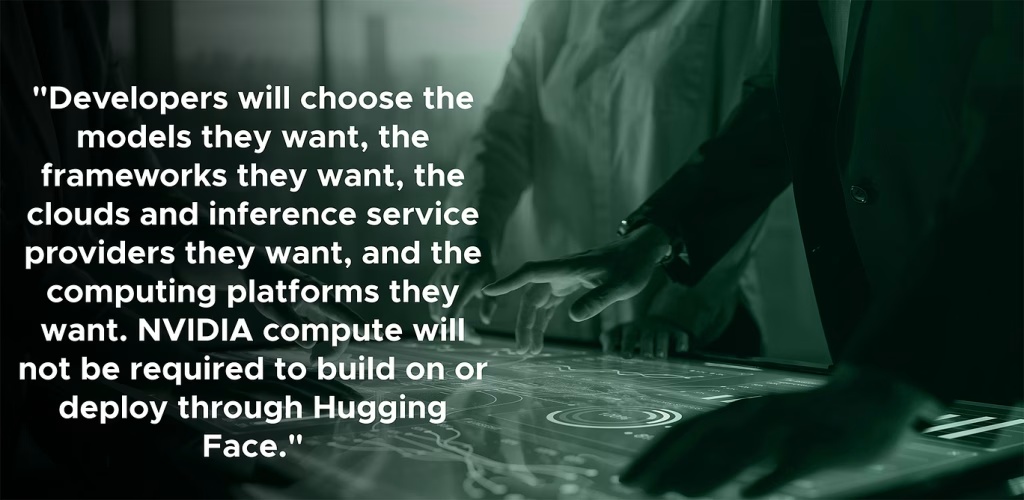
While official assurances state that Hugging Face will continue supporting multi-cloud environments and alternative hardware accelerators (such as AMD, Intel, or Google TPUs), the industry will be watching closely.
Here is what you can expect in the short to medium term:
1. Seamless Hardware-to-Software Optimisation
NVIDIA’s primary strength lies in its CUDA software architecture and high-performance GPUs.
Expect Hugging Face’s model hosting and deployment pipelines to feature native, one-click optimisations for NVIDIA hardware, making inference faster and significantly cheaper for enterprise customers.
2. Enhanced Enterprise Safety and Evaluation
One of the traditional criticisms of open-source AI compared to proprietary models has been the lack of standardized safety guardrails and evaluation frameworks.
With NVIDIA’s engineering capacity behind it, Hugging Face can offer enterprise-grade safety tools, making open-source models far more appealing to heavily regulated industries like healthcare and finance.
3. The Multi-Cloud Question
The core promise of Hugging Face has always been neutrality, a marketplace where developers can deploy anywhere. Maintaining this vendor-neutral stance will be vital for keeping the trust of its 18 million users.
Should the platform favor NVIDIA infrastructure too heavily over time, community backlash could give rise to alternative open repositories.
Final Thoughts: A New Era for Open AI
NVIDIA acquiring Hugging Face marks a pivotal moment in technology history. It cements open-source AI not as a hobbyist alternative to proprietary APIs, but as the foundational architecture of the modern global economy.
As we predicted, hardware manufacturers and software hubs are joining forces to build the end-to-end “AI factories” of tomorrow.
If NVIDIA honours its commitment to keeping Hugging Face multi-platform and truly open, this $12.9 billion deal could accelerate open-source innovation faster than ever before.